

French Harder!
An air crash, the politics of language and the dangers of unresolved tension

Let’s say you’re the CEO of a national air carrier. It’s a big job that comes with lots of pressure! One of your aircraft is involved in a runway crash that results in the tragic deaths of two pilots and injuries to a number of passengers. All the early indications are that your airline is not at fault. But, as CEO, it is your responsibility to communicate sentiment on behalf of the company, and to explain the actions the company is taking.
You record a four minute video in which you offer condolences for deaths of the pilots and explain what you are doing to support the passengers and other crew members. You are appropriately solemn. You say all the right things, considering the circumstances. Job done, right?

Maybe not…
It is a public relations truism that poor communication can make a crisis worse. Typically, that means things like responding too late, getting demonstrably ahead of the facts, omitting or obfuscating important information, or releasing inconsistent or muddled messages.
Or, one might be “tone deaf,” meaning your remarks sound poorly calibrated to the gravity of the situation or the feelings of stakeholders. A canonical example of tone deafness is a remark by Tony Hayward, CEO of BP during the Deepwater Horizon explosion and oil spill. In the midst of apologizing for the situation on TV during what was supposed to be a shirtsleeves “we’re fixing it!” PR hit, he said, “There’s no one who wants this thing over more than I do. I’d love my life back.” This was after 11 people died on the rig and the gulf coast fishing industry was wiped out.
Three days later, he was apologizing for his apology. Always a bad sign! A few weeks later, he was out.1 The statement wasn’t the only reason but it sure didn’t go in the board’s “keep him” column. Here is advice: live your life so you are never used as a case study of crisis comms gone terribly wrong!
Could you be considered tone deaf just for delivering an otherwise appropriate statement in the wrong language?
Yes! In Canada, you could be considered politically tone deaf for that, and politicians are a stakeholder group, especially if you’re the Canadian national air carrier.
In his video, released the day after the crash, Air Canada CEO Michael Rousseau delivered all the right messages. Within a day he was blasted for delivering his remarks only in English, though with French subtitles. Canadian Prime Minister Mark Carney criticized Rousseau directly, and a parliamentary committee that oversees Canada’s language laws invited Rousseau to explain himself. Within three days, Rousseau was apologizing for his apology, Tony Hayward-style. Lawmakers pressured him to resign.
Eight days after the crash, Air Canada announced that Rousseau had informed the board of directors that he would retire by the end of September. The statement made no mention of the controversy. It didn’t need to.
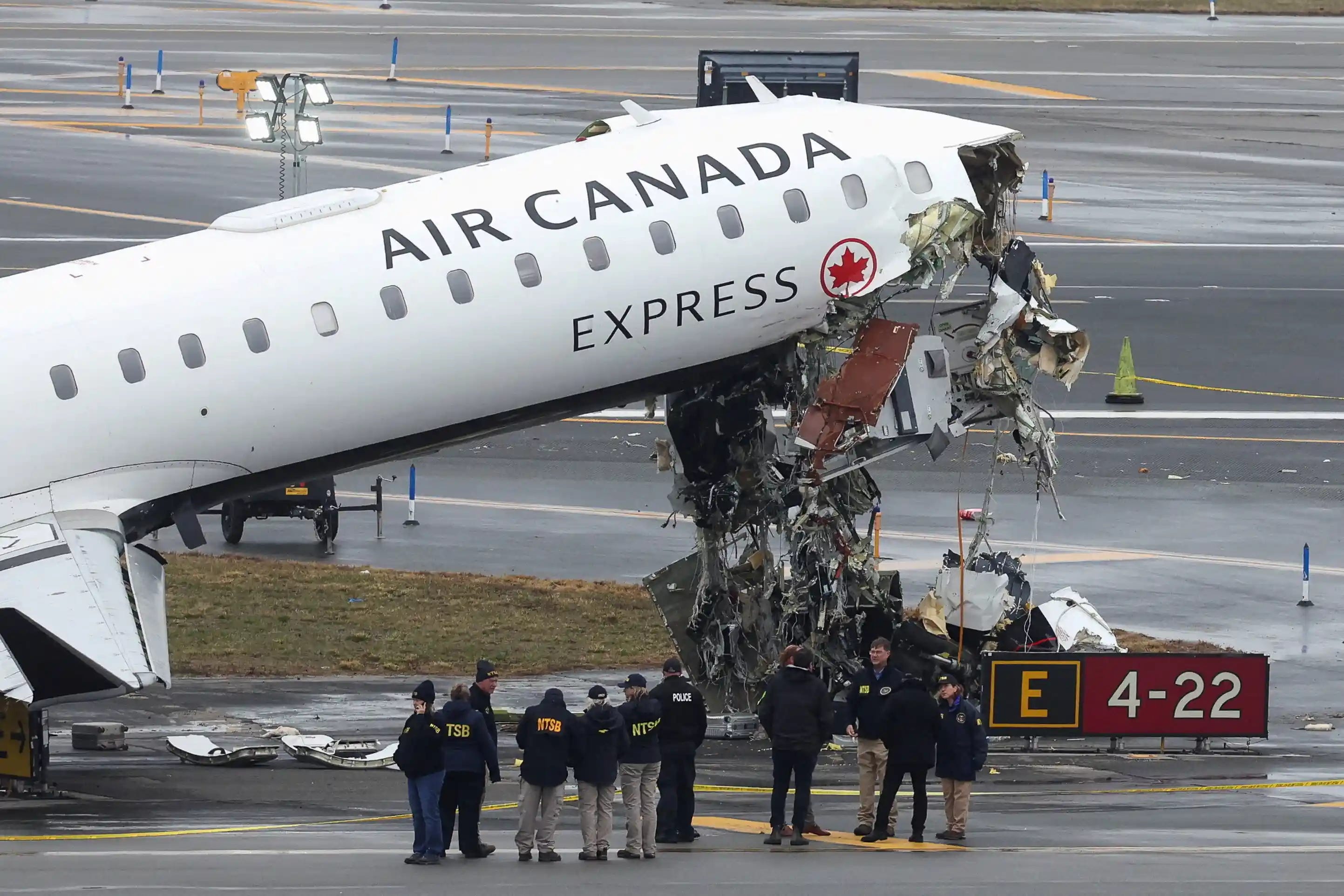
With an exception we’ll get to below, CEOs are the ultimate owners of accountability and crisis communication at a company. Airline CEOs carry a special burden. It is blessedly rare, but there is always a chance an airline CEO might have to communicate about an air crash, among the most traumatic, high-pressure and news-generating corporate crises possible.2
I assume that airline CEOs are appointed mostly because boards of directors think they will be good at managing the stupendous operational complexity of a modern airline. But, ideally, you also want someone who can communicate effectively in the event of a crisis. It’s not just for crashes! Airlines have labor issues and network disruptions, any of which can leave tens of thousands of customers vocally enraged. Here’s a well-known video of Southwest CEO Bob Jordan addressing a catastrophic holiday network disruption three years ago.
Watch Bob Jordan, and then watch Rousseau’s video from after the Air Canada crash, in the tweet above, if you haven’t already.
Rousseau is not good at this! He’s struggles to read smoothly from the prompter. His delivery is halting, there are obvious edits, and he mispronounces some basic words. I have done TV from a prompter, when I had a brief stint as a television software reviewer in Singapore back in the nineties. It’s a skill and it takes practice! You don’t want to discover this in a crisis.
But the halting delivery could be forgivable as long as the demeanor and messaging are correct, which they are. The thing that sunk Rousseau was that, two words aside, the address was in English.
Language is political, especially in multilingual countries. It’s definitely political in Canada, where the Quebecois have both an independence movement and a fierce dedication to preserving the French language. The BBC gets into why this was a specific problem for Rousseau:
Rousseau lives in Montreal [Quebec] but is an anglophone. His uniligualism was the subject of criticism from some when he was appointed as CEO of Air Canada in 2021.
Shortly after his appointment, he was asked by a journalist why he has not learned French despite living in Quebec for more than a decade.
Rousseau responded: “If you look at my work schedule, you’d understand why” - a comment that garnered backlash from both Quebec and federal ministers at the time.
Rousseau later apologised and committed to improving his French.
…
Air Canada began as a federal public corporation and has been private since 1988. It remains subject to Canada’s Official Languages Act, however, and announcements on board planes are made in both English and French.
I recently wrote that one of my first questions in a crisis situation is, “who is this a crisis for?” The Air Canada situation started as a crisis for the Airline, but within a couple of days it had become mostly a crisis for the CEO. Suddenly, you’re solving a different problem!
Imagethief’s Theory of Unresolved Tension
In my PR career, I’ve learned to be wary of the risks of what I think of as, “unresolved tension.” This is the material fact not disclosed, the thing someone might want to leak, the issue you hope won’t be discovered. It might be something scandalous, or it might be just the awkward gap between a significant corporate decision and the official announcement. It can be anything that would invite a reporter to dig for “the rest of the story.” In all cases, I would rather relieve the tension on my own terms than have the media or political antagonists do it for me on ground of their choosing. In a big company, there is always a certain amount of unresolved tension, and you learn to recognize the stuff you should worry about.
Rousseau’s lack of French language ability was unresolved tension that existed from the moment he was appointed. It was a known problem that had been publicly reported on, but as long as things at Air Canada were business-as-usual, it could be ignored. The moment Rousseau’s limitations were exposed by a crisis requiring a very sensitive kind of public communication, he was in trouble. The booby trap was set years ago. The LaGuardia crash just hit the tripwire.
Could Rousseau have faked his way through the video? Maybe, but he struggled to deliver his remarks from the prompter in English. I suspect he would have mangled French to the point of ridicule, and perhaps made the situation even worse.
One could argue that this is a silly standard by which to judge a CEO who seemed to be delivering solid business results, or that the outrage was politically motivated. But it doesn’t matter. Language is political, and, as a Quebec-headquartered company, the bilingual expectations of an Air Canada CEO were widely known and codified in policy.
If Rousseau had admitted six months ago that his French still wasn’t up to scratch and publicly redoubled his efforts to learn it, he could have relieved the tension on his own terms and it might not have been a scandal. Maybe he would have bought himself enough grace to get through the crash.
But the crash let the issue escape containment and Rousseau’s antagonists set all the terms for the PR battle that followed. The crisis switched from managing the accident to managing a problematic CEO. I said above that the CEO is accountable for a company crisis, with one exception. The board of directors is accountable for a CEO crisis. I don’t know if Rousseau made the decision to resign or if the board pushed him out, but either way, they’re probably happy he’s leaving. In a delicate moment, he had become, as they say, a distraction.
I don’t know much French, but I know this: C’est la vie!
Stepped down by “mutual agreement with the board,” but, fired.
Before my PR career, I worked for a Singapore Internet consultancy that built and operated Singapore Airlines’ website. I got my intro to airline crisis comms during the crash of SQ006, in Taiwan, in 2000. This was a 747 that crashed on takeoff with 83 fatalities, at about 11PM. I pulled all-nighter publishing the airline’s periodic news updates on their website.
Imagine how much fun they could've had 6 months ago, with a video series with some cute kid teaching the CEO French! The guy coulda won over legions of fans, got some laughs, and as a bonus, actually learned the language. Next time I guess.
Spot on as usual Will. Question: if Air Canada and Rousseau knew of his inability to speak French, what is they used one of the AI tools to convert his English comments into French? I’ve seen some very impressive examples. Not sure if any can translate into Quebec French, which has its own accent and some vocabulary that differ from standard French. Would that have helped? Or made a bad situation even worse in your opinion?