

The People v. McRib
The press bites on a sandwich lawsuit

Here’s a possibly controversial theory: Lawyers are just specialized PR people.
I can hear my lawyer friends clenching their jaws, but hear me out. Contracts are communication. Courtrooms and arbitration hearings are communication. Demand letters are communication. And class action lawsuits are definitely communication, often written both to advance a legal argument and to generate press attention.
Here’s a fun example: "Le, Lynch, Baker and Wilson v. McDonalds Corporation.” The complaint is entertaining, and the first two paragraphs set things up better than any summary I could write:
“The McRib is back!” is a phrase recognized across the United States, stirring excitement among McDonald’s customers eager for the limited-time sandwich offering. For decades, McDonald’s has cultivated a sense of anticipation around the McRib, leveraging its scarcity to drive sales across its many locations. Fans eagerly await each return, trusting that the sandwich they’re biting into is exactly what the name implies: a sandwich crafted using pork “rib” meat, which is prized by consumers for its high fat content and rich flavor.
The reality, however, is far from what McDonald’s advertising and branding suggest. Despite its name and distinctive shape—its meat patty has been deliberately crafted to resemble a rack of pork ribs—the McRib does not contain any actual pork rib meat at all.
The italics are in the original, just to make sure you get it.
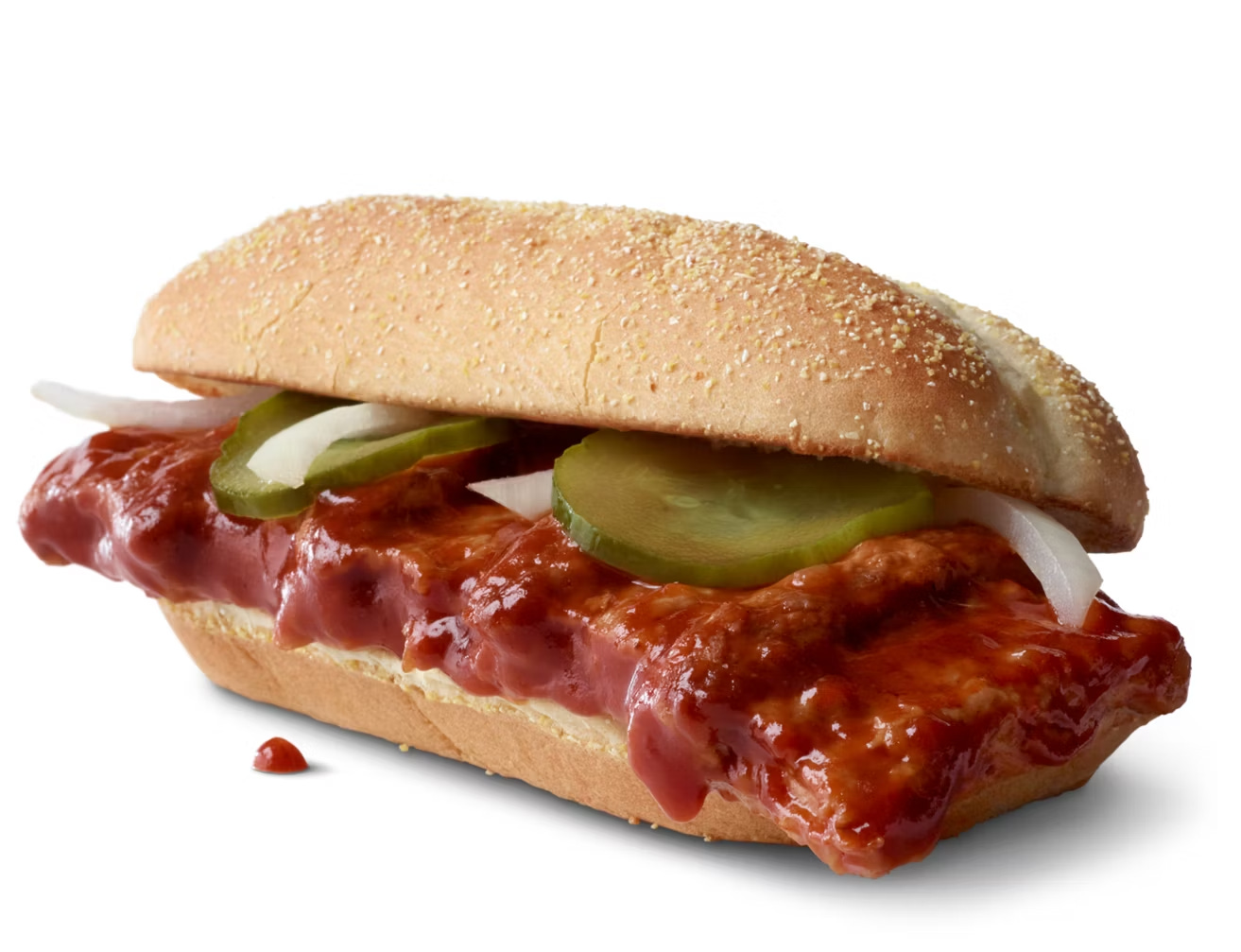
If the McRib isn’t rib meat, what is it? I’m glad you asked, and so are the lawyers who filed the suit!
Instead, [the McRib’s] meat patty is reconstructed using ground-up portions of lower-grade pork products such as, interalia, pork shoulder, heart, tripe, and scalded stomach.
“You sold people a sandwich marketed as a ‘McRib’ that contained no rib meat” isn’t Love Canal-level on the harm-o-meter, so the gross-out line is there as a lure for the press and social media posters. Did it work? You bet it did! Here’s the New York Post:
The primary ingredient of the sandwich, which has found a cult following thanks in part to its on-again, off-again status on McDonald’s menu, is restructured pork composed of parts like shoulder, heart, tripe and scalded stomach, the complaint alleges.
The alleged ingredients also get repeated by CBS Chicago, NBC Chicago, USA Today, MSN and Newsweek, among others. I love that the Newsweek article has a breathless, Axios-style “Why It Matters” section for a sandwich lawsuit. But why settle for that when you can read the actual Axios article? Naturally, someone on Bluesky invoked Upton Sinclair’s gross-out labor classic, The Jungle:
McDonalds is headquartered in Chicago, which probably explains the prominence of Chicago media in the early coverage. I assume the plaintiff’s lawyers shopped the complaint around to the media. I would! The idea is to put reputation pressure on McDonalds, presumably to encourage a settlement. The nasty ingredients add a little zest to what is otherwise a pretty low-stakes complaint, “Why It Matters” notwithstanding.
It’s interesting to follow the sourcing on the organ meat allegation in the complaint. The footnote points to a Chicago Magazine article from 2011 about the invention of the McRib that is not especially negative. The part that invokes the specific organ meats is drawn from a 2011 book about processed meat in general. Here’s the quote from the book, as reproduced in the Chicago Magazine article:
“Most people would be extremely unhappy if they were served heart or tongue on a plate,” he observed. “But flaked into a restructured product it loses its identity. Such products as tripe, heart, and scalded stomachs are high in protein, completely edible, wholesome, and nutritious, and most are already used in sausage without objection.” Pork patties could be shaped into any form and marketed in restaurants or for airlines, solving a secondary problem of irregular portion size of cuts such as pork chops. In 1981 McDonald’s introduced a boneless pork sandwich of chunked and formed meat called the McRib, developed in part through check-off funds [micro-donations from pork producers] from the NPPC [National Pork Producers Council]. It was not as popular as the McNugget, introduced in 1983, would be, even though both products were composed of unmarketable parts of the animal (skin and dark meat in the McNugget). The McNugget, however, benefited from positive consumer associations with chicken, even though it had none of the “healthy” attributes people associated with poultry.
The “he” in the first sentence above—the source of the list of organ meats—is a Mr. Roger Mandigo, who is described by Chicago Magazine as, “a longtime prof at [the University of Nebraska, Lincoln] a recent inductee into the Meat Industry Hall of Fame and an innovator in restructured meat products.”
I did not know there was a Meat Industry Hall of Fame. Now I do, and so do you! If you’re interested, this year’s induction ceremony is on January 26th, at the Georgia World Congress Center, and there is (barely) still time to RSVP. Please go, and send me a report!
More relevantly, the quote above states that “tripe, heart, and scalded stomachs” are commonly used in processed meats. It also notes that the McRib is “composed of unmarketable parts of the animal.” It does not specifically state that tripe, heart, and scalded stomachs are in the McRib. They might be, but we don’t know that from the citation in the lawsuit. But the implication was enough for the plaintiff’s lawyers to run with.
I don’t know if that will matter legally, but it was great PR, because the press couldn’t resist the ick! factor. The media all used some form of “the lawsuit alleges” in their articles because they have their own lawyers looking over their copy. It’s lawyers all the way down.
McDonalds’ statement on the issue is what I would call principles-focused, and it doesn’t exactly refute the list:
“We’re committed to using real, quality ingredients across our entire menu,” McDonald’s USA wrote. “Our fan-favorite McRib sandwich is made with 100% pork sourced from farmers and suppliers across the U.S. We’ve always been transparent about our ingredients so guests can make the right choice for them.”
Does the USDA definition of “pork” include organ meats? Unclear! And perhaps context-specific. There is apparently some distinction between “pork” and “pork products” or “byproducts.” But I promise you that McDonalds’ lawyers signed off that “100% pork” formulation.
The lawsuit’s point isn’t that it is intrinsically wrong to sell someone a pig-innard sandwich. The lawsuit’s point is that it’s deceptive and harmful to (allegedly) market a (by implication, nasty) pig-innard sandwich as a scrumptious pork rib-meat sandwich. Presumably, if McDonalds marketed it as something like McChitlin Deluxe, that would be fine. To set this up, the complaint asserts that pork rib meat is a premium cut:
“Pork rib meat is derived from the muscle and fat found on a pig’s rib cage. The two main types of pork rib meat are spare ribs—thick, juicy cuts from the bottom of the rib cage—and baby back ribs—leaner but tender cuts cut from the top portion of the rib cage. Both are considered “premium” cuts of pork that command higher prices to match.”
More on “premium” later! Also, this bit is entertaining:
“Additionally, consumer confusion surrounding the true contents of the McRib is exacerbated by McDonald’s efforts to promote the McRib as a special, limited-time item. This cycle of sporadic availability creates a sense of urgency that discourages deep consumer scrutiny and deters sustained discussion or scrutiny into its actual ingredients, which further bolsters the longevity of consumer misconceptions regarding the sandwiches’ rib meat content.”
Consumers will be in such a hurry to get their limited-time McRibs that they’ll forego the thorough and diligent research that might otherwise lead them to discover the true composition of the sandwich! The plaintiffs lawyers have more faith in the rigor of the American consumer than I do.
Marketing the unmarketable meat
What’s desirable meat and what’s undesirable—or “unmarketable”—is a cultural artifact. When Roger Mandigo says, “Most people would be extremely unhappy if they were served heart or tongue on a plate,” I think he means most white Americans would be unhappy.
My wife is Singaporean and one of her favorite meals is Teochew kway chap, which is all of these same pig parts in soup form. Our local Chinese supermarket sells pig bung (sphincter), as well as kidneys, brains and many other unglamorous parts. So do the carnicerias in my heavily latino neighborhood.
The role of meat in national diet is also a cultural and political creation, as is apparent from the masculinization of red meat consumption in America. Mandigo, ever the advocate for processed and restructured meat products, notes that miscellaneous organs and scraps are acceptable even to the organ-averse when made into sausage.1
These perceptions evolve over time. Pork ribs might be a premium cut today, as the complaint asserts, but they were originally cast-offs, harder to ship and sell than the premium cuts of the time. There is a long tradition of marginal foods being elevated into gourmet treats.
The complaint against McDonalds wants to have it both ways. The harm it asserts is not that consumers were placed at physical risk, but that they overpaid by a couple of bucks for an allegedly deceptively advertised sandwich. But it relied on disgust and implied unwholesomeness to drive publicity. And it worked! I am unqualified to assess the legal strategy, but the PR strategy was effective.
I doubt it will make much difference to McDonalds in the long run. The McRib has been around for more than forty years. I don’t know if McDonalds has been sued over it before, but it has had many prior bouts of bad press. Here’s a story from just over a year ago. Back in 2014, McDonalds hired former “Mythbusters” cast member Grant Imahara for a video designed to de-mystify the McRib. There is a long-running conspiracy theory that the McRib’s unpredictable sales are designed to take advantage of changes in pork prices. And the Simpsons poked fun at the McRib more than 20 years ago, with the Krusty Burger Ribwich.

Arguably, the McRib itself is a kind of PR masterpiece. It keeps on generating press. And it keeps on selling. You can’t go wrong with mystery meat in sugary sauce! But it would be fun if a McRib scandal made it to trial. Especially a criminal trial! Picture the scene in the courtroom:
Prosecutor: And this sandwich you ate, you were led to believe it was premium pork rib meat?
Witness: Yes. I was promised thick, juicy cuts.
Prosecutor: And what was it actually?
Witness: It…it was…[breaks down sobbing]
Prosecutor: [Gently] Take your time.
Witness: [Resolve stiffening] It was pork shoulder, heart, tripe, and scalded stomach.
Audience in gallery: [Gasps in horror, except my wife, who looks intrigued]
Prosecutor: And is the person who perpetrated this outrage here in the courtroom?
Witness: [Jabs a finger at Ronald McDonald, seated at the defendant’s table] It was him!
Prosecutor: We rest our case
Judge: [Scowling at Ronald] You’ll burn for this, clown.
[Law and Order noise]
Justice is served with your choice of BBQ, Spicy Sichuan or Honey Mustard sauce.
Longtime readers will know that I am a confirmed fan of both liverwurst and liverwurst-related PR scandals.
I do enjoy a good false ad lawsuit, as I am sure you know. I will be interested to see whether this one can even survive a motion to dismiss. I would put my money on McDonald's. My assumption is that most Americans who consume a McRib are at this point aware of its mystery meat status, and don't care. I am sure you will be shocked to know that I don't believe I have ever eaten on in my life.
I echo Mr. De Vido's appreciation of the line "Audience in gallery: [Gasps in horror, except my wife, who looks intrigued]"
I am proud to say that I have never had a McRib. While I, like your wife, enjoy the occasional tripe soup, the McRib just doesn't look appealing to me. Your write up all but assures that I never will have a McRib. Tripe belongs in soup, not in a sandwich. Now if McDonald's sold a tongue sandwich...