Nobody thinks about what happens with their accumulated text messages and emails. Intellectually, we might understand that these communications persist, logged and archived by telcos and IT departments, saved on other people’s devices, ready to be exhumed at awkward moments. But we don’t believe it in our bones. These messages feel so weightless and ephemeral, like social media posts. And who ever got in trouble for a social media post?
Nobody ever got in trouble for subscribing to Imagethief!
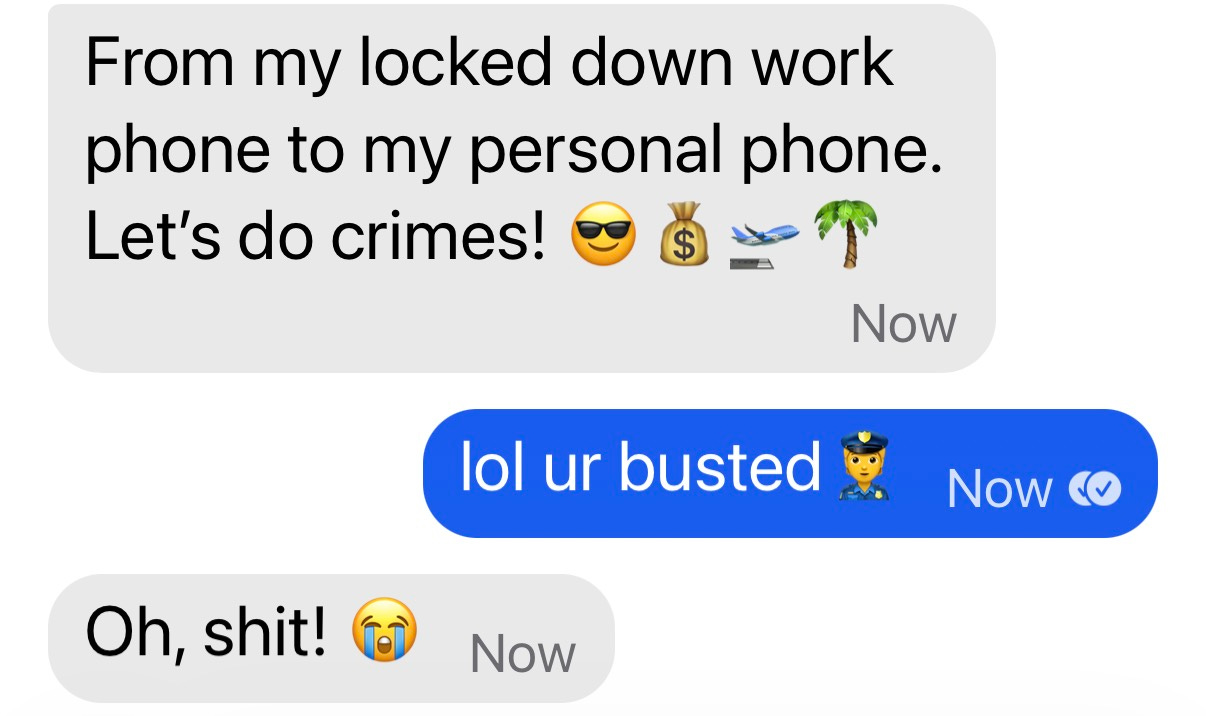
The more paranoid might use encrypted messaging services, like Signal, beloved of journalists, dissidents and random people who have heard the word “opsec.” These services are resistant to some kinds of interception, but they’re not bulletproof. You still have to trust the person you’re texting. For example, here is a text message I sent on my work Signal from my super-strapped down, no-screenshots company phone to my personal Signal on my everyday phone, which is happy to take screenshots and automatically synchronize them with Google Photos.
Nothing is stopping me from spilling all my own secrets to you, the reader! (Except fear of losing my job, income, health insurance, place in society, etc.)
Kimberly Guilfoyle was preparing for her congressional hearing to become U.S. ambassador to Greece when she reached out to a Trump donor with an urgent request: She needed $100,000 that she said she owed American Express—in a way that wouldn’t leave a paper trail.
“It won’t show up anywhere if you wire money to American Express,” she wrote on Signal, according to messages reviewed by The Wall Street Journal. “Please.”
For months, Guilfoyle had been chatting with Eric Deters, a former congressional candidate in Kentucky who was seeking her help in getting the attention of the new Trump administration on some personal tax and legal issues—and had promised payments of as much as $1 million if she was successful. As Donald Trump Jr.’s former fiancée, Guilfoyle offered to use her sway, according to Deters and messages reviewed by the Journal. She forwarded Deters the messages she’d sent to the new Internal Revenue Service chief and updated him on her efforts to lobby the Justice Department on his behalf.
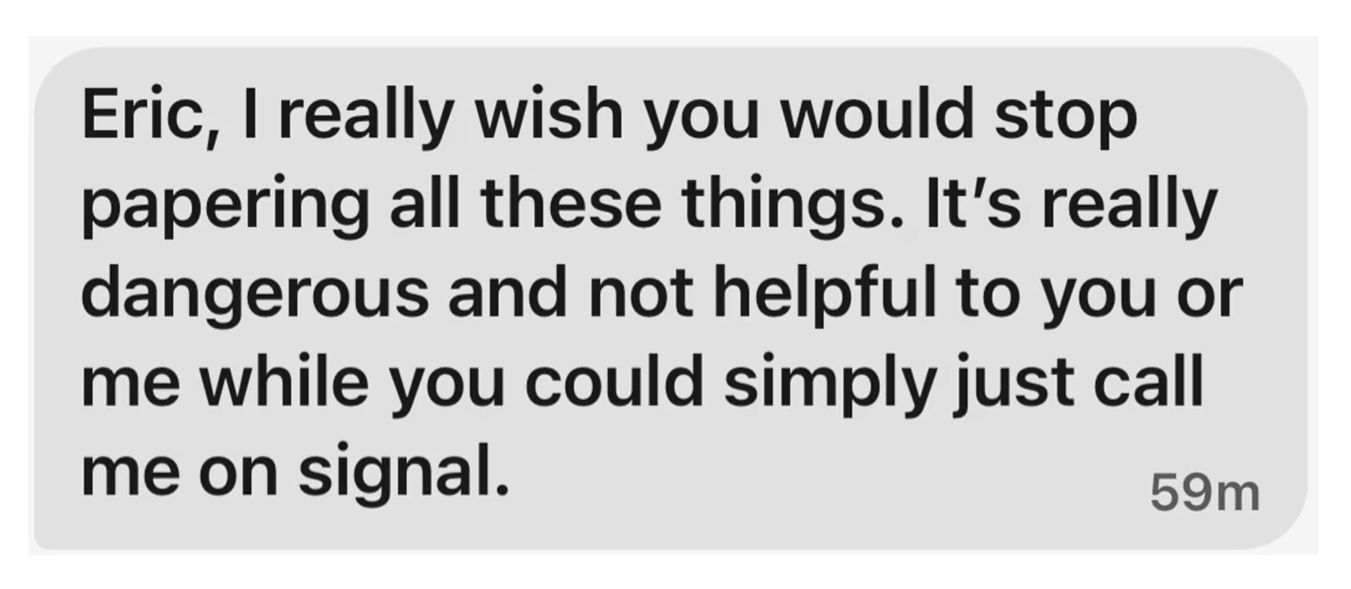
The whole story is delirious, and worth a read. It is lavishly illustrated with screen shots of Signal messages, including one in which Guilfoyle pleads with Deters to stop sending risky text messages.
Guilfoyle also expressed concern about her dealings with Deters becoming public—and the effect that could have on her ambassador post. She warned Deters repeatedly not to commit talk of money or payments to text. “Eric, I really wish you would stop papering all these things,” she wrote in one exchange.’
Deters was interviewed on the record and appears to have furnished the text messages and other documents to the reporters. The story suggests that Deters was unhappy with services rendered (or, as it happens, un-rendered) by Guilfoyle as a MAGA fixer. I guess he expressed his dissatisfaction by nuking Guilfoyle from orbit in the pages of the Wall Street Journal.
Relatable! Who among us hasn’t wanted to publicly rinse a disappointing vendor? You and I would do this in a mean, one-star Google review because the national press probably isn’t interested in hearing that we had a mid meal at Red Robin or wherever. If you’re Kelly Clarkson, with nine million followers on X, give or take, you put a Brooklyn boutique on blast. But this! This looks like a cold-blooded assassination by Deters. And a classic case of counterparty disclosure risk, which no amount of encryption will protect you from.
Silence is Golden (Says the Blogger)
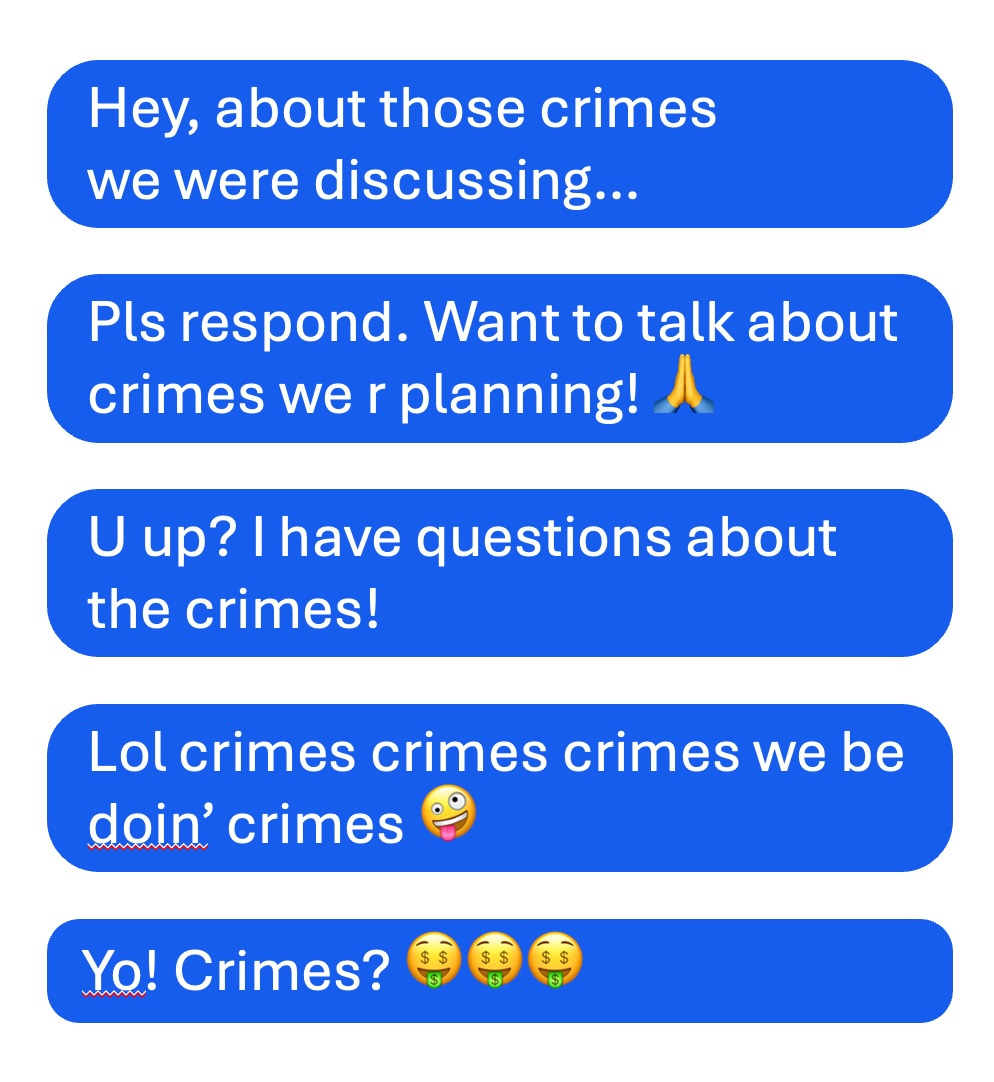
Here’s a scenario. Imagine you’ve been plotting some crimes with someone. They start sending you text messages about your planned crimes:
You, being smart, recognize that these messages are at best deeply embarrassing, at worst potentially incriminating and (totally hypothetically) a threat to your cushy, Mediterranean ambassadorial gig. How do you respond? Do you send this reply?
Ideally not?
I’m not a lawyer and not qualified to explain to you what legal jeopardy you might place yourself in with such an exchange. Some, I’d guess? But I am qualified to say that you will place yourself in all kinds of reputational jeopardy when the Wall Street Journal publishes this exchange. This is a cartoony example, but it's only mildly exaggerated compared to Guilfoyle’s exchange, above.
Whether you’ve been actually plotting crimes or not, the correct response if your co-conspirator starts texting you (or emailing you) potentially incriminating messages is to shut the fuck up! Don’t respond. Don’t acknowledge the messages. Don’t text back, “We should discuss this by voice,” or anything like that. Definitely don’t text back, “What a nightmare you’ll literally cost me my ambassadorship stop writing,” as Guilfoyle did.1
As always, the main thing is to not do shady things. If you’ve been doing actual crimes or just ethically compromised stuff, text message discipline might not save you. If your counterparty is planning to burn you to the Feds, there will probably be lots of evidence beyond your text messages.
But if they’re planning to burn you to the Wall Street Journal, or if the conversation is surfaced in legal discovery, a one-sided thread you never respond to is going to be way more boring than the one in which you worry aloud that the messages are going to blow up your career. And if a reporter should happen to buttonhole you and ask about the texts, you’ll have a basis for pleading ignorance. “I don’t recall seeing those. I get lots of texts, what with all the midterm election spam.”
Because we’re normal people, we’re all too casual with our emails and text messages, and none of our archives can withstand excavation. My work Microsoft Teams chats at both my previous employer and my current one are full of harmless but dumb stuff I wouldn’t want to try to explain out of context with my job on the line. I’ve had my bloodlessly professional work emails read back to me by lawyers in the context of an internal investigation for a situation where I wasn’t even the subject and that was bad enough. God help me if I have to explain emojis or my Gen-X over-reliance on the ¯\_(ツ)_/¯ emoticon.
A good starting point is to remember that everything is archived. All the Gmails. All the text messages. All the Slack and Teams threads. You can use an encrypted messaging service with disappearing messages that expire after a set amount of time, like Signal. You can be an ultra-nerd and PGP all your emails so that only you and your counterparty can read them. But you still have to trust that your counterparty isn’t saving everything for their own purposes. (Kids: don’t send nudes!)
This goes double for work devices managed by your employer. Depending on how uptight your company is, IT might be logging every keystroke and input on your work devices. Keyloggers will sit in front of an encrypted messaging app. In fact, I wonder if I’ll have to explain myself for my dumb demonstration at the top of this post, where I was texting between Signal accounts on my work and personal phones.
HR lawyer: When you texted, “Let’s do crimes,” to what crimes were you referring?
Me: There weren’t any crimes. It was a joke.
HR lawyer [as if he’s never heard the word]: A “joke?”
Me: I was trying to show that an encrypted messaging service wouldn’t necessarily protect messages from disclosure.
HR lawyer: So, was it a joke or a demonstration?
Me [strained]: Both?
HR lawyer [writing something down]: Mm hm. And who were you texting?
Me: Myself.
HR lawyer: Is that something you do often?
Me: I have this blog…
HR lawyer: What’s the meaning of this sequence of emojis? [holding up a printout of 😎💰🛫🌴]
Me: Uh, it’s meant to represent getting our loot and getting on a plane to a tropical island.
HR lawyer: Your loot from the crime you claim you weren’t committing?
On going around and coming around and underneath the sun there being no new thing: literally our first ever conversation was this but with B-list Hong Kong slebs…





On going around and coming around and underneath the sun there being no new thing: literally our first ever conversation was this but with B-list Hong Kong slebs…